
 AI and Workforce Trends04 Jun 2025
 AI and Workforce Trends • 09 Jul 2025
 Story Insights
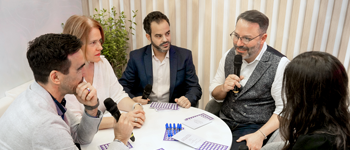
At this year’s VivaTech conference in Paris, ManpowerGroup brought together business leaders for unique card-game-inspired ‘Table Talks’ sessions to spotlight the most important innovations in HR and AI adoption. Attendees shared their thoughts on how AI will affect recruitment, jobs, and the changing role of the CEO. They were also asked to consider ethical questions presented on a series of 'wild cards', and to predict what they would be discussing at VivaTech in 2030, 2040 and beyond. This article presents the highlights of their conversations.
A Revolution in Hiring?
For years, companies hired staff based on human-led assessments of formal qualifications followed by rounds of interviews - a process that has proven to be significantly flawed.
“A few years ago, we were spending almost 70% of our recruitment time interviewing the wrong people,” admits Atreya Chaganty, CEO of Quantanite, a customer-experience and digital-outsourcing solutions provider. “Our quality of assessments was low, and the ability to categorize and screen people was not very sophisticated.”
Chaganty argues that the rapidly shifting technology landscape has fundamentally altered the criteria that companies should apply in selecting the best talent. For one thing, he says, AI can often handle the more-technical component of work, which means that people’s softer skills now have greater value within an organization.
“There’s definitely a trend that, at least in some functions, in some areas, a growing number of employers are saying, you know, universities no longer teach anything that is relevant for today and especially not for tomorrow,” he says.
He also points out that the shifting premium on skillsets away from formal qualifications towards soft skills presages a potentially more democratic hiring process that opens the door to people who didn’t have the chance to go to university.
“If AI makes knowledge or credentials obsolete and it helps us in organizations to look at these soft skills, it can be a big equalizer, even for people who don't come from privileged backgrounds but have the drive, work ethic, people skills and the desire or hunger to learn.”
David Sebaoun, Executive Partner Hybrid Cloud, Data & AI, IBM Consulting, says that using AI in the recruiting process can also help introduce greater objectivity. “When humans look at CVs, they have some bias,” he says. “It’s not to say that AI should have the final word but it can bring different criteria and objectivity to assess people.”
In Chaganty’s case, AI now plays an integral part of the hiring process, employing the technology to analyze interview videos and audio transcriptions as part of a “scoring” process that elevates the importance of soft skills. “Today, we have really taken it to the other extent where we work almost completely autonomously with artificial intelligence,” he says.
Automation vs. Augmentation
WrIf consensus dictates that AI has an important role to play in hiring and HR, the jury is still out over how big that role should be. Does the advent of AI inevitably point to technology taking over entire areas of the workplace or does it simply represent an additional tool that humans can use to perform their jobs?
Tomas Chamorro-Premuzic, Chief Innovation Officer, ManpowerGroup, sees the debate in the context of a journey that has only just begun. “We are still at a place where most organizations are pursuing an augmentation strategy in which they see AI as not eliminating people but eliminating tasks,” he says. “But at the same time, we see a slowing down in hiring and certainly a lot of tech companies cutting down.”
Meanwhile, Cécile Clavier, Head of Digital Transformation and Innovation, Nestlé France, says that her own company is deploying AI across its wide portfolio of companies where there is the greatest need and benefit rather than adopting a one-size-fits-all approach.
“We have different levels of maturity in the company so we see that some businesses or functions are more advanced, and we take a view on what is important for the company and what is needed.”
For all the lack of a clearly defined trend, Sylvain Letourmy, Business Development Leader, Oracle, argues that there are signs of a growing maturity in companies’ use of AI that is breeding more confidence in taking a next step towards automation.
“This journey has been an opportunity to build trust with AI,” he says. “We started with use cases around augmentation that allowed us to build an understanding of what AI produces. As that understanding has increased, we are starting to automate with some confidence.”
Sebaoun of IBM also sees a growing maturity in the use of AI, and one that brings potentially huge benefits. “A lot of companies started to deploy AI for the user experience, to make jobs cool. Then they realized they could make productivity gains, and then they understood that the hours you save can be reinvested into new business acquisitions.”
Leadership and Purpose
As the prospect and potential of AI changes the nature of work throughout organizations, upheaval is affecting all levels. But what does it mean for CEOs and company leaders? For Muriel Vidémont-Delaborde, Senior Partner, Kearney, the increasing role of AI within the workforce should prompt CEOs to embrace three qualities that go beyond a vision for growth and a duty to shareholders:
“It is not redefining leadership but putting forward some of the qualities of the good leader,” she says. “You have to care for your people, and it is even more true with AI today.”
Sebaoun of IBM believes that the rise of AI will oblige business leaders to focus increasingly on three areas:
Writing the Future
With the exponential pace of technological progress, perhaps the biggest question concerning AI and HR is how it will affect the world of work years from today. Participants in the card game were asked to choose a year and put some thoughts down on what could be on their minds when that date rolls around.
For Vidémont-Delaborde, 2035 will be about AI and ethics, AI and geopolitics as well as winning business models.
By 2040, says Sebaoun, the defining word will be “hybrid”. “By then, you will have a lot of new technologies but you will still need to think about how to mix those technologies together, integrate them, transform and scale.”
And further into the future? Clavier of Nestlé France smiles. “Perhaps by 2050, we will be discussing agents’ and robots’ rights,” she says.
With thanks to our Table Talks participants:
Sylvain Letourmy
Business Development Leader, Oracle
Cécile Clavier
Head of Digital Transformation and Innovation, Nestlé France
David Sebaoun
Executive Partner Hybrid Cloud, Data & AI, IBM Consulting
Muriel Vidémont-Delaborde
Senior Partner, Kearney
Tomas Chamorro-Premuzic
Chief Innovation Officer, ManpowerGroup
Atreya Chaganty
CEO, Quantanite
AI and Workforce Trends04 Jun 2025


